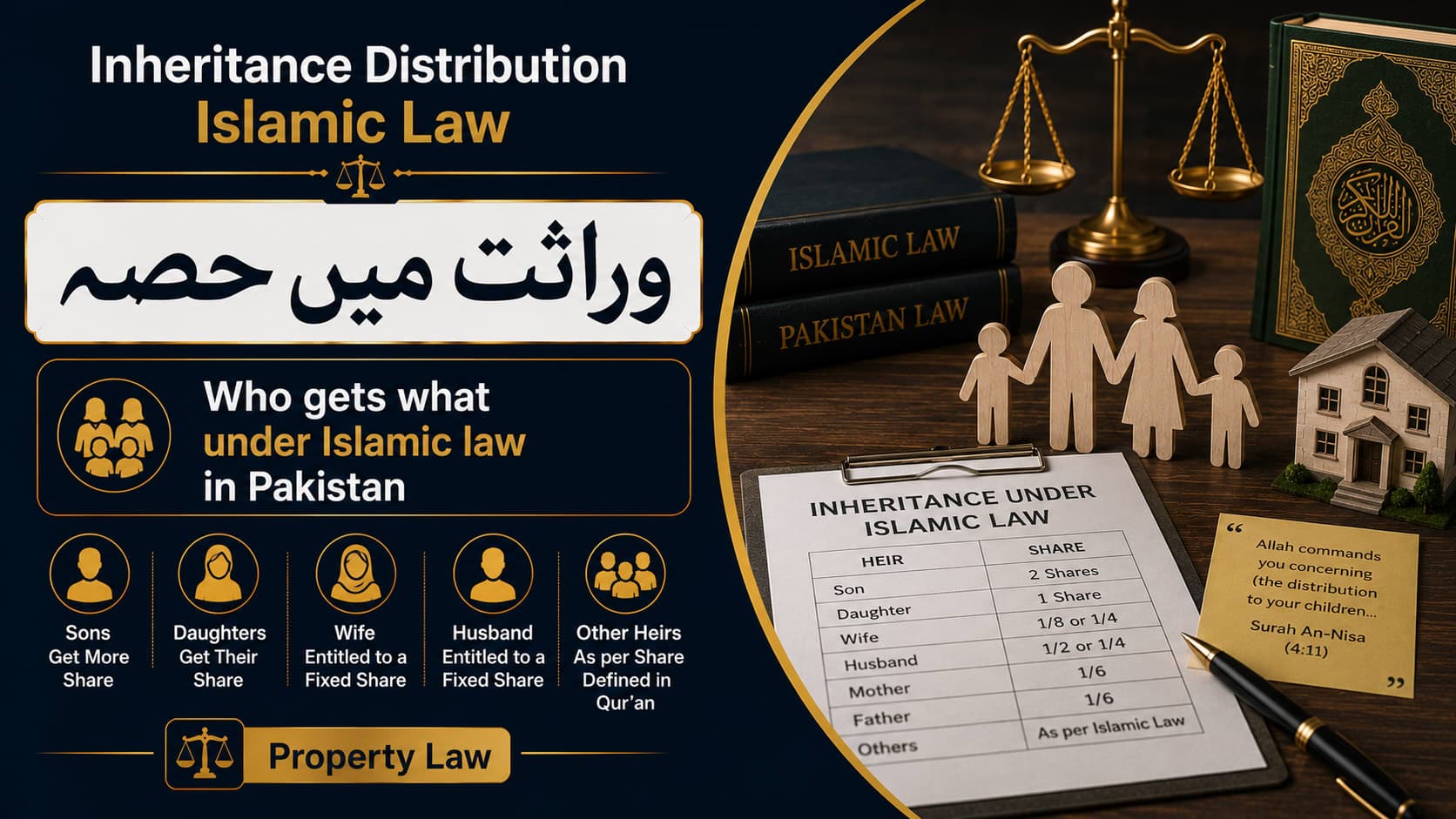
Inheritance Distribution Under Islamic Law in Pakistan (2026): Shares & How to Claim
In Pakistan, inheritance for Muslims is governed by Islamic law under the Muslim Personal Law (Shariat) Application Act, 1962. The Quran prescribes specific shares for each category of heir, and these are legally enforceable — no family member can be lawfully deprived of their share without their consent. This guide explains the main inheritance shares, how distribution works in practice, and how to claim your legal share when family disputes arise.
For help with an inheritance dispute in Karachi, WhatsApp Adv Zain Ul Abdin Kharal or call +92 300 0872473.
Which law governs inheritance in Pakistan?
For Muslim citizens of Pakistan, inheritance is governed by the Muslim Personal Law (Shariat) Application Act, 1962, which provides that the Muslim personal law of the Quran and Sunnah shall apply in matters of inheritance, succession, and related matters. The courts apply Islamic jurisprudence in determining who inherits and in what shares.
The Succession Act, 1925 applies to non-Muslims and in some procedural aspects of succession certificates.
The basic principle: everyone gets their Quranic share
No one — not the eldest son, not a dominant sibling, not whoever happens to be in physical possession of the property — has the right to claim more than their Quranic share or to exclude another legal heir. Every heir's share is legally protected and can be claimed through the courts if withheld.
Common inheritance shares at a glance
The following are the shares in the most common scenario — a deceased person survived by a spouse, children, and parents. Islamic inheritance law is complex and the exact shares shift depending on who is present as a survivor. These figures are a guide, not a substitute for legal advice on your specific family composition.
Spouse's share
Scenario | Wife's Share | Husband's Share |
|---|---|---|
Deceased has children | 1/8 | 1/4 |
Deceased has no children | 1/4 | 1/2 |
Children's shares
Son and daughter together: A son receives double the share of a daughter (the "aul" principle of 2:1).
Daughters only (no son): Two or more daughters together share 2/3 of the estate; a single daughter gets 1/2.
Sons are residuary heirs (asabaat) — after fixed shares are distributed, residue goes to the son(s).
Parents' shares
Scenario | Father's Share | Mother's Share |
|---|---|---|
Deceased has children | 1/6 | 1/6 |
Deceased has no children (but has siblings) | Residuary | 1/3 of residue |
Deceased has no children, no siblings | Residuary | 1/3 |
Important: These shares apply in the most straightforward scenarios. The presence or absence of certain heirs changes shares significantly. A scholar of Islamic law and a lawyer should be consulted for complex family compositions.
What if someone has been excluded or their share withheld?
This is the most common inheritance dispute in Karachi: a property remains in the name of the deceased, one or a few family members claim or use it, and other legal heirs are not given their share. Every legal heir — including daughters, a surviving spouse, and parents — has the right to claim their share, regardless of what family arrangements say.
The legal remedies are:
Suit for partition — filed in the civil court to formally divide the estate proportionally among all heirs.
Declaration suit — establishing your share in the court's record.
Succession certificate — required for moveable assets (bank accounts, securities) and applied for in the Succession Court.
The succession certificate — for moveable assets
If the deceased left bank accounts, savings certificates, shares, or other moveable assets, the heirs need a succession certificate issued by a court to access and transfer these assets. Banks and financial institutions will not release funds to heirs without one.
The application is made to the District Court, notice is published, and after the process the court issues the certificate naming the heirs and their shares.
Mutation (intiqal) for inherited immoveable property
For land and property (immoveable assets), the inheritance is established through mutation of the property records into the heirs' names at the relevant land authority (Revenue Department, KDA, DHA, etc.). This requires:
Proof of death (death certificate)
Proof of relationship (family registration certificate / NADRA records)
Succession / legal heirship documents
Any required court declaration
Mutation formally transfers the record of the property into the heirs' names in the correct shares.
Common inheritance disputes in Karachi
The most frequent issues our clients bring:
Daughters excluded by brothers — fully illegal; daughters have a clear Quranic right.
Property kept in the deceased's name for years — prevents sale or mortgage by any heir, and risks squatters or qabza.
One sibling managing and then claiming the entire property.
Step-family disputes — where remarriage created multiple sets of children.
Overseas Pakistani heirs not informed of a death and excluded from the estate.
Property sold without all heirs' consent — such a sale can be challenged in court.
Overseas Pakistani inheritance claims
If you are overseas and have inherited property in Karachi, you can pursue your claim through a power of attorney authorising a Karachi lawyer to file for succession certificate, partition, and mutation on your behalf. Distance is not a barrier to claiming what is legally yours.
How we help in Karachi
Adv Zain Ul Abdin Kharal at Kharal Law Associates handles inheritance disputes, succession certificates, partition suits, and mutation applications across Karachi — DHA, Clifton, Gulshan-e-Iqbal, Gulistan-e-Johar, North Nazimabad, Nazimabad, PECHS, Saddar, Korangi, Malir, North Karachi, and Scheme 33.
Frequently asked questions about inheritance in Pakistan
Do daughters have inheritance rights in Pakistan? Yes. Under Islamic law as applied in Pakistan, daughters have a clear Quranic right to inherit. A daughter's share is half that of a son's in the same degree. Excluding daughters from inheritance is legally invalid and can be challenged in court.
What share does a wife get when her husband dies? If the deceased husband has children, the wife receives 1/8 of the estate. If he has no children, she receives 1/4.
How do I get my inheritance if the property is still in the deceased's name? Apply for mutation of the property into the heirs' names at the relevant land authority, supported by a death certificate, relationship proof, and legal heirship documentation. A succession certificate from court may also be required for moveable assets.
Can one heir sell inherited property without the others' consent? No. All co-heirs must consent to a sale. A sale by one heir of the whole property without others' consent can be challenged and set aside.
How do I claim my inheritance as an overseas Pakistani? Through a power of attorney, a Karachi lawyer can pursue your succession certificate, partition suit, and mutation on your behalf without you being physically present for most steps.
What is the deadline to claim inheritance? Limitation periods apply to certain types of claims. Act promptly — delays can complicate the case. Consult a lawyer as soon as you become aware of an inheritance issue.
Protect your inheritance rights
Your Quranic share is your legal right — no family arrangement can permanently take it from you. WhatsApp Adv Zain Ul Abdin Kharal or call +92 300 0872473 for a confidential consultation.
Frequently Asked Questions
Yes. Under Islamic law as applied in Pakistan, daughters have a clear Quranic right to inherit. A daughter's share is half that of a son's in the same degree. Excluding daughters from inheritance is legally invalid and can be challenged in court.
If the deceased husband has children, the wife receives 1/8 of the estate. If he has no children, she receives 1/4.
Apply for mutation of the property into the heirs' names at the relevant land authority, supported by a death certificate, relationship proof, and legal heirship documentation. A succession certificate from court may also be required for moveable assets.
No. All co-heirs must consent to a sale. A sale by one heir of the whole property without others' consent can be challenged and set aside.
Through a power of attorney, a Karachi lawyer can pursue your succession certificate, partition suit, and mutation on your behalf without you being physically present for most steps.
Limitation periods apply to certain types of claims. Act promptly — delays can complicate the case. Consult a lawyer as soon as you become aware of an inheritance issue.
Need a Lawyer for This in Karachi?
Our advocates can help. Explore the related practice area:

Written / Reviewed by
Advocate Zain ul Abdin KharalAdvocate High Court, Sindh High Court Bar Association
Litigation, Advisory & Representation