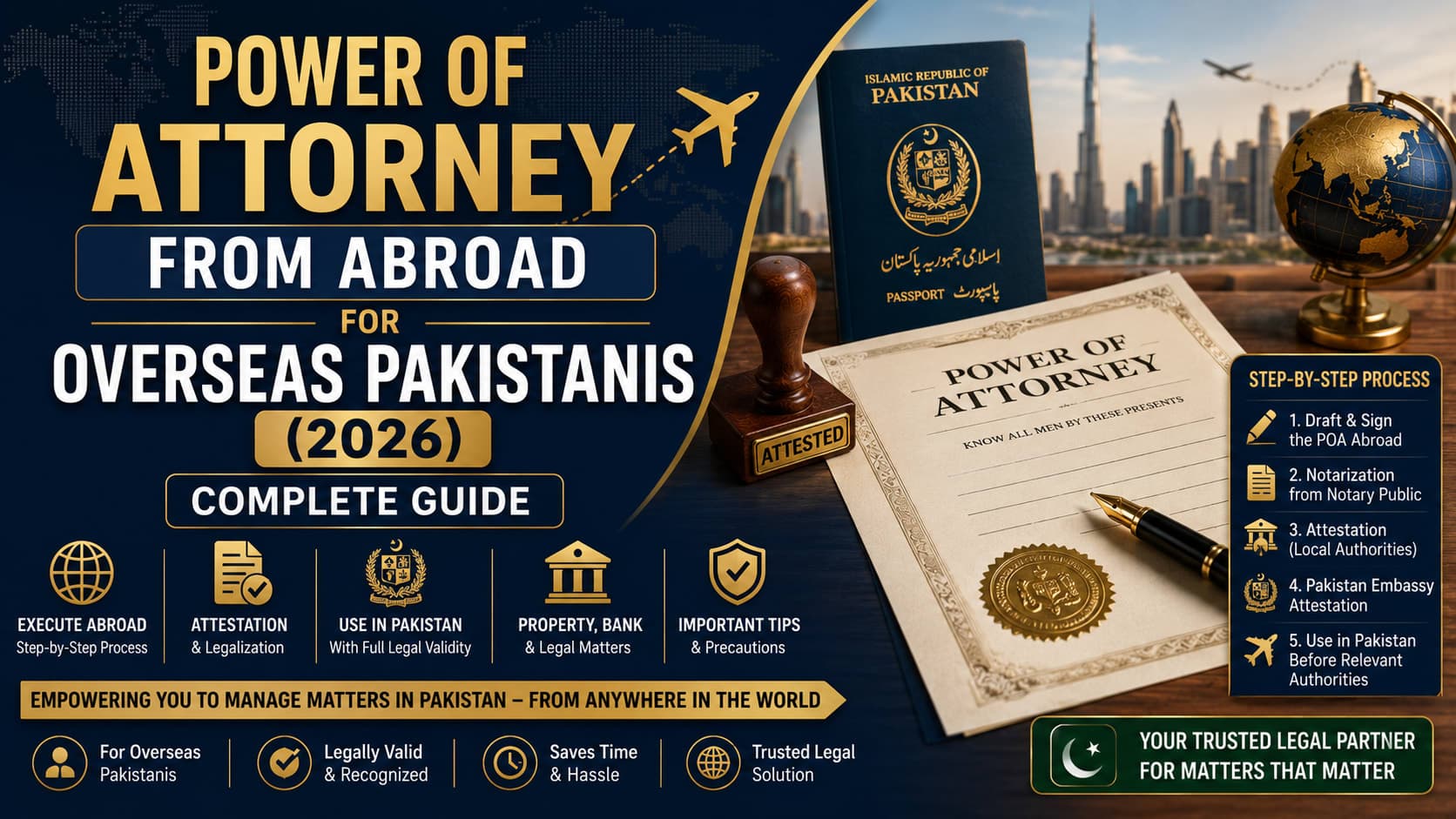
Power of Attorney from Abroad for Overseas Pakistanis (2026): Complete Guide
A Power of Attorney (POA) is the single most important legal tool for an overseas Pakistani who needs anything done in Pakistan — property bought or sold, a court case filed, inheritance claimed, or a divorce pursued — without being physically present for every step. A properly executed and attested POA authorises a trusted person or law firm in Karachi to act on your behalf, sign documents, and represent you legally. This guide explains the exact process for making a POA from abroad in 2026.
To get a POA drafted, attested, and registered for your Pakistan matter, WhatsApp Adv Zain Ul Abdin Kharal or call +92 300 0872473.
What is a Power of Attorney?
A Power of Attorney is a legal document in which you (the principal) authorise another person or firm (the attorney-in-fact or agent) to act on your behalf in legal, financial, or property matters. In Pakistan, a POA gives your designated representative the authority to appear before courts, sign property documents, file applications, and carry out other specified acts — without you being present.
For overseas Pakistanis, the POA is not just useful — it is often the only practical way to handle matters in Pakistan while living abroad.
General POA vs Special POA — which do you need?
General Power of Attorney | Special Power of Attorney | |
|---|---|---|
Scope | Broad — covers multiple or all legal/financial acts | Specific — covers one defined purpose only |
Risk | Higher — broad authority requires a very trusted person | Lower — limited to the stated purpose |
When to use | Ongoing property management, multiple simultaneous matters | A single specific transaction (one sale deed, one court case) |
Duration | Usually ongoing until revoked | Often expires when the specific act is completed |
Recommendation for most overseas clients: Use a Special POA for specific matters (one property sale, one khula case, one succession certificate). If you have multiple ongoing Pakistan matters, a General POA with a trusted lawyer is appropriate — but understand the scope of authority you are granting.
Step-by-step: making a POA from abroad
Drafting the POA
Contact your Karachi lawyer first. They draft the POA in the correct Pakistani legal format, including:
Full name and CNIC/NICOP number of the principal (you)
Full name and CNIC of the attorney (the person you are authorising)
The specific powers being granted — drafted precisely for your purpose
The Pakistani law governing the document
They send you the draft electronically for review before you proceed to signing.
Step 2 — Sign before a Notary Public in your country of residence
Once you approve the draft, you sign the POA before a Notary Public in the country where you are based. The Notary witnesses your signature and notarises the document. In most countries:
UK: Notary Public (different from a solicitor — a specialist notary is required for international documents)
UAE/Saudi Arabia/Gulf: Notary Public at the Notary's office
USA/Canada: Notary Public (widely available)
Australia/Europe: Notary Public or equivalent
Step 3 — Attestation by the Pakistani Embassy or Consulate
The notarised POA must be attested by the Pakistani Embassy or Consulate in your country of residence. This confirms to Pakistani authorities that the document was genuinely signed before a notary and is authentic.
Visit the Pakistani Embassy/Consulate or use their postal/appointment service.
Pay the attestation fee.
The Embassy stamps and signs the document.
Apostille — an alternative in Hague Convention countries
Pakistan is a party to the Hague Apostille Convention. In countries that are also party to the Convention (which includes the UK, UAE, USA, Canada, Australia, and most of Europe), an apostille from the relevant government authority may be accepted in place of Embassy attestation for some purposes.
Verify before publishing: Confirm with your Karachi lawyer whether apostille or Embassy attestation is required for your specific purpose and the current year, as requirements vary by purpose and can change.
Step 4 — Send the original to Karachi
The attested original POA (not a photocopy) is couriered to Karachi. Your lawyer then registers or produces it before the relevant authority (Sub-Registrar, court, or housing authority) as required for the purpose.
Stamping and registration in Karachi
For certain purposes — particularly property transactions and court proceedings — the POA may need to be stamped and registered at the relevant office in Karachi after receipt. Your lawyer handles this.
What can a POA cover?
A properly drafted POA can authorise the attorney to:
Buy or sell property — sign sale deeds, pay taxes, complete registration
File and pursue court cases — khula, maintenance, qabza, inheritance, recovery suits
Apply for succession certificates and mutation — inheritance matters
Execute documents on your behalf
Manage property — collect rent, pay dues, manage utility connections
Deal with NADRA/NICOP matters
Negotiate and settle disputes (if specifically authorised)
Common mistakes to avoid
Using a photocopy — always send the original attested document.
Granting broad authority to an unverified person — only authorise someone you deeply trust, or a regulated law firm.
Not having the draft reviewed by a Pakistani lawyer before signing — the format must be correct for Pakistani law.
Not registering the POA where registration is required for the specific purpose.
Forgetting to revoke a General POA once your matters are concluded.
Countries we serve overseas Pakistani clients from
We regularly assist clients based in the UK, UAE, Saudi Arabia, USA, Canada, Australia, Qatar, Oman, Bahrain, Kuwait, Germany, Norway, Sweden, and Denmark in preparing POA documentation for their Pakistan matters.
How we help
Adv Zain Ul Abdin Kharal at Kharal Law Associates drafts Special and General POAs, guides clients through Embassy attestation, registers POAs in Karachi, and acts as attorney-in-fact for overseas Pakistani clients across all matters — property in DHA, Clifton, Gulshan, PECHS, North Nazimabad, Korangi, Malir, and across Karachi.
Start your POA — handle your Pakistan matters from abroad
WhatsApp Adv Zain Ul Abdin Kharal or call +92 300 0872473. We draft the document, guide you through attestation in your country, and manage everything in Karachi on your behalf.
General legal information for Pakistan — not legal advice on your specific case. Attestation requirements vary by country and purpose — confirm current procedures with a qualified lawyer.
Frequently Asked Questions
A General POA grants broad authority across multiple matters. A Special POA is limited to one specific act or transaction. For most overseas Pakistanis, a Special POA for each specific matter is safer.
Yes, in most cases — the notarised document is presented to the Embassy/Consulate for attestation. Many Embassies offer appointment-based or postal services. Apostille may be an alternative in some countries — confirm with your lawyer.
Yes. Appointing a law firm as your attorney under a Special POA for a specific matter (a property case, a khula, an inheritance claim) is a common and appropriate arrangement.
From drafting to receipt of the attested original in Karachi, typically one to three weeks depending on Embassy appointment availability and courier transit time.
Yes. A POA can be revoked by the principal at any time by executing a revocation deed. If the POA was registered, the revocation should also be registered.
Need a Lawyer for This in Karachi?
Our advocates can help. Explore the related practice area:

Written / Reviewed by
Advocate Zain ul Abdin KharalAdvocate High Court, Sindh High Court Bar Association
Litigation, Advisory & Representation