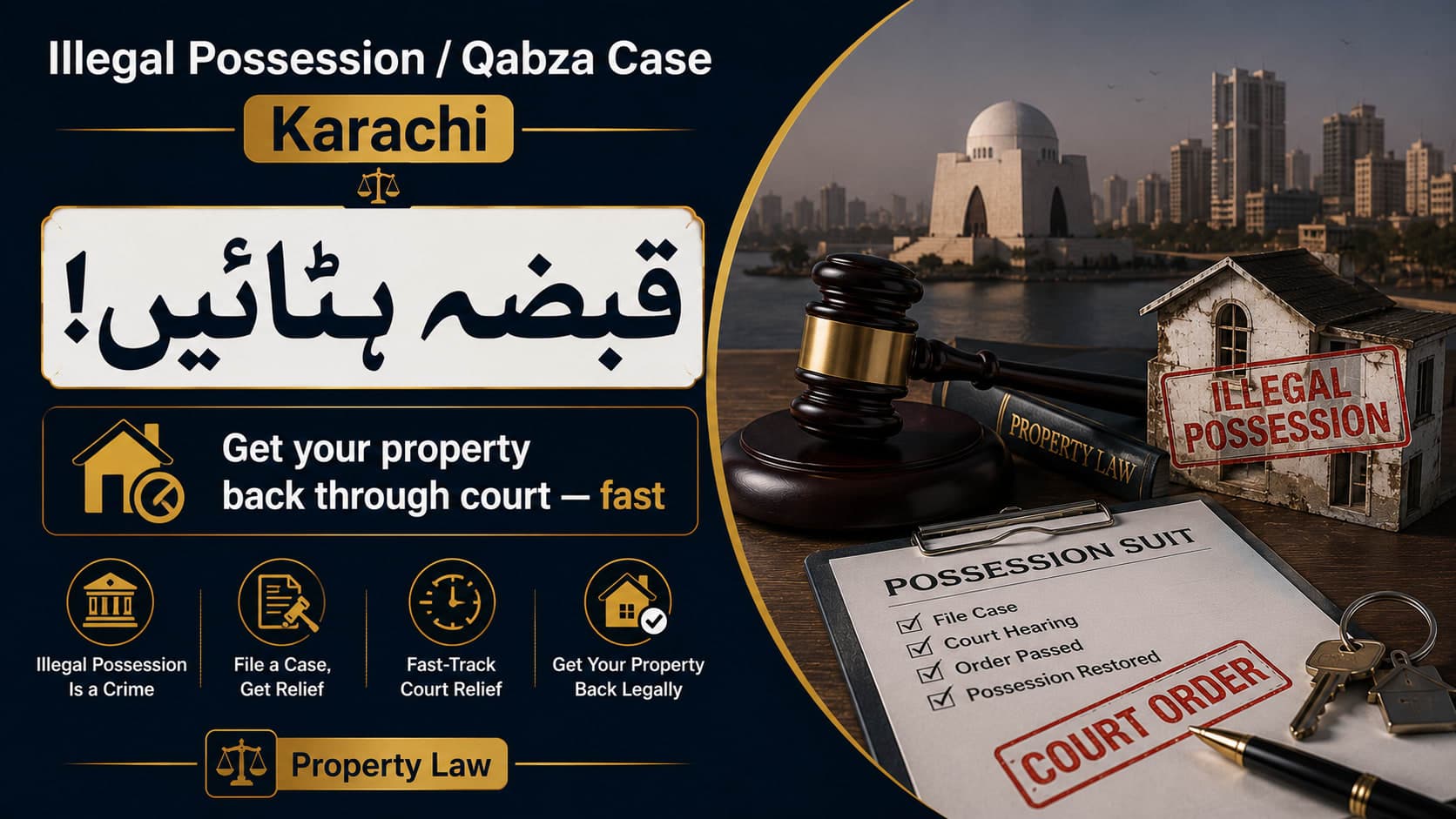
Illegal Possession (Qabza) Case in Karachi: How to Remove Encroachment (2026)
Illegal possession — qabza — of property is one of the most painful and common legal problems in Karachi. Whether a neighbour, family member, or land-grabbing group has occupied your plot, house, flat, or commercial property, the law gives you clear routes to recover it: a civil suit for possession in the District Court, backed by an urgent injunction to stop any further damage or construction, and a criminal FIR for trespass. This guide explains both routes, how to choose the right one, and what the process looks like step by step.
For immediate help with a qabza case in Karachi, WhatsApp Adv Zain Ul Abdin Kharal now for a confidential consultation.
What is qabza (illegal possession) in legal terms?
Qabza refers to someone taking or occupying your property without your consent and without any legal right to be there. This includes:
A neighbour constructing on or encroaching upon your plot
A family member refusing to leave or claiming sole ownership of jointly held property
A tenant who refuses to vacate after the lease ends
An organised land-grabbing group occupying a plot left unattended
A builder or society fraudulently registering your property in someone else's name
Illegal encroachment on a shop, commercial space, or agricultural land in peri-urban Karachi
The longer qabza continues unchallenged, the harder it becomes to reverse — particularly if the occupier starts constructing. Acting quickly is essential.
Two main routes: civil suit vs criminal FIR
When dealing with qabza, a good property lawyer evaluates both routes simultaneously, not as alternatives, but as tools that can be used together:
Civil route: suit for possession + injunction
The primary legal remedy for recovering property is a civil suit for possession and mesne profits filed in the District Court having jurisdiction. Alongside the main suit, the most critical immediate step is filing for an urgent interim injunction under Order 39, Rule 1 and 2 of the Code of Civil Procedure (CPC) — this asks the court to prohibit the illegal occupier from constructing, altering, selling, or further encroaching on the property while the case runs.
A well-drafted injunction application, filed swiftly with supporting documents, can result in a court order within days that freezes the situation.
Criminal route: FIR for criminal trespass / encroachment
Under the Pakistan Penal Code (PPC):
Section 441 defines criminal trespass — entering property to commit an offence or intimidate the owner.
Section 447 provides punishment for criminal trespass.
Section 448 covers house-trespass.
For more serious organised qabza with threats, additional sections for robbery, extortion, or dacoity may apply.
A criminal FIR at the local police station runs parallel to the civil case. While criminal proceedings do not themselves restore your possession, they create legal pressure, generate an official record, and can lead to arrest of the encroachers — which is sometimes the most effective short-term tool.
If police refuse to register the FIR (which happens), your lawyer can apply to the Judicial Magistrate under Section 22-A CrPC for a direction to register.
Step-by-step: how to fight a qabza case in Karachi
Documents required
Your case is built on title. Locate:
Original title documents — sale deed, allotment letter, transfer letter (for DHA, KDA, society plots), or relevant court order
Registered Nikah Nama / succession documents if the property came through inheritance
Property tax receipts (utility and municipal tax records are supporting evidence of possession and use)
Photographs and video of the illegal occupation — dated, with GPS if possible
Witness details — neighbours, witnesses to the original purchase
Act quickly
Do not wait. Every day without legal action allows the occupier to strengthen their position — and if they begin construction, removal becomes more complex. Bring all documents to a property lawyer who can assess the strength of your title and advise on which court has jurisdiction.
Civil suit and injunction
The lawyer files the main civil suit for possession and a simultaneous urgent injunction application. The court can hear the injunction ex parte (without the defendant present) in genuine emergency cases, issuing a stay order the same day.
Step 4 — Serve notice on the occupier
The court issues notice on the occupier to appear and respond. If they fail to appear, the case proceeds ex parte in your favour.
Police complaint
Go to the local police station (or police facilitation centre) with your title documents and a written complaint describing the illegal occupation. Your lawyer can accompany you and ensure the FIR is properly registered.
Step 6 — Trial and decree
The main civil case runs through evidence, arguments, and judgment. With strong title documents and an honest history of purchase/possession, courts in Karachi do award possession decrees.
Step 7 — Execution of decree
After obtaining the decree, if the occupier still does not vacate, you apply for execution of the decree. The court sends a bailiff with police assistance to take actual possession of the property.
Karachi-specific complications to know
Karachi's land administration is fragmented differently from other cities, and this affects your case strategy:
DHA property: Disputes involving DHA allotment letters, transfer letters, and possession are handled through civil courts, but DHA's own records office is often the key for title evidence.
KDA / government schemes: Original allotment letters, lease deeds, and transfer through KDA's formal process.
Cooperative societies: Often have their own by-laws and internal dispute mechanisms, but civil courts have overriding jurisdiction.
Cantonment areas: Cantonment Board has its own land administration; property here may require engagement with the Cantonment executive.
Informal settlements / katchi abadis: More complex — separate policy and legal framework.
Knowing which scheme your property is in determines which records apply and which body's documents carry weight.
What if the encroacher has also registered forged documents?
This is a more serious situation — sometimes the illegal occupier has registered a fraudulent sale deed or transfer document through corrupt practices. In this case:
A civil suit for declaration and cancellation of fraudulent documents is filed alongside the possession suit.
A criminal complaint for forgery and fraud under PPC Sections 420, 467, 471 is filed.
Courts routinely cancel fraudulent registrations where the original owner proves their legitimate title.
Do not panic if you discover a fake document — this happens regularly in Karachi's property market, and courts have well-established remedies.
How we help in Karachi
Adv Zain Ul Abdin Kharal at Kharal Law Associates handles qabza cases across Karachi, including DHA, Clifton, Gulshan-e-Iqbal, Gulistan-e-Johar, North Nazimabad, Nazimabad, PECHS, Bahadurabad, Saddar, Korangi, Malir, North Karachi, Surjani Town, Orangi, Landhi, and Scheme 33. We move quickly on injunction applications — because in qabza cases, speed is everything.
Recover your property — don't wait
Every day of delay makes your case harder. WhatsApp Adv Zain Ul Abdin Kharal or call +92 300 0872473 for urgent, confidential advice on your qabza case.
This article is general legal information for Pakistan and is not legal advice on your specific case. Consult a qualified property lawyer urgently if your property has been illegally occupied.
Frequently Asked Questions
Contact a property lawyer immediately and gather your title documents. The first legal step is filing an urgent injunction application to freeze the situation and stop further construction or damage.
Yes, but civil recovery of possession requires a court order. A criminal FIR for trespass puts the matter on record and creates pressure, but actual recovery of property is through the civil court's possession decree and execution.
The injunction can be obtained quickly — sometimes within days in urgent cases. The full civil trial for possession takes longer, often a year or more. But the injunction protects you during that time.
Your lawyer can apply to the Judicial Magistrate under Section 22-A CrPC for a direction to the police to register the FIR.
Yes, but limitation periods apply. A lawyer should be consulted immediately — delays can bar your claim. Act now.
This is a double-sell / fraud situation. File a civil suit against the builder for fraud and specific performance or recovery of money, and simultaneously pursue the occupier for possession. Criminal FIR against the builder for cheating (Section 420 PPC) is also an option.
Need a Lawyer for This in Karachi?
Our advocates can help. Explore the related practice area:

Written / Reviewed by
Advocate Zain ul Abdin KharalAdvocate High Court, Sindh High Court Bar Association
Litigation, Advisory & Representation