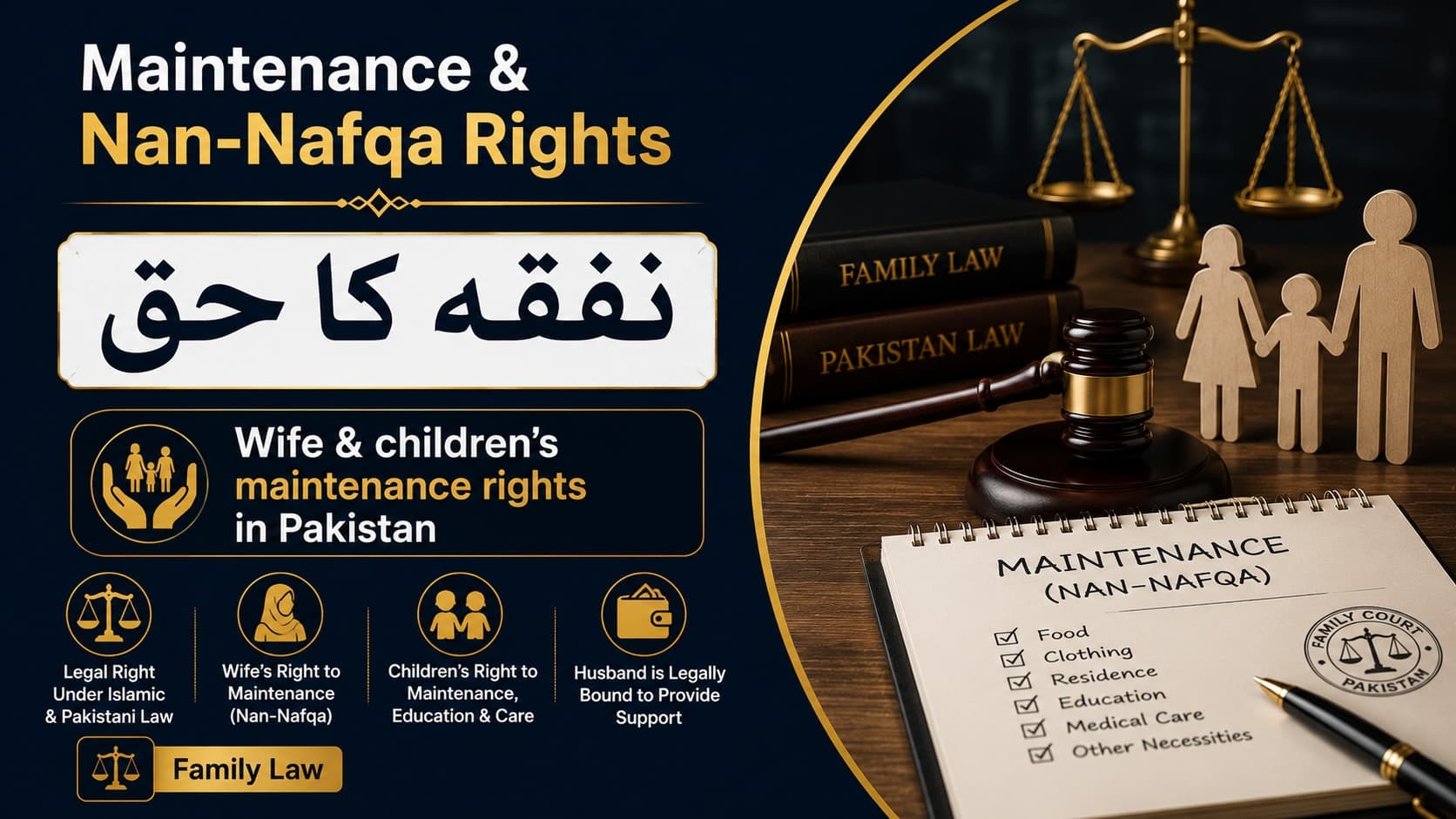
What is nan-nafqa (maintenance) under Pakistani law?
Nan-nafqa refers to a husband's financial obligation to support his wife and children. It covers the necessities of life — food, shelter, clothing, and other reasonable needs. This obligation arises from the marital relationship and, for children, from parenthood itself.
Pakistani courts take maintenance obligations seriously. If a husband fails to fulfil them, the wife and/or children can approach the Family Court, which can order payment and enforce it.
Wife's right to maintenance during marriage
A husband is obligated to maintain his wife during the subsistence of the marriage, provided she is not in willful breach of her marital duties. This obligation exists regardless of the wife's own income or financial means — maintenance is her right under the marriage contract, not a charity.
If a husband abandons the wife, refuses to live with her without valid cause, or fails to provide basic necessities, the wife can apply to the Family Court for a maintenance order even while still married.
Wife's right to maintenance after divorce (iddat period)
After talaq or khula, a wife is entitled to maintenance during her iddat period — the prescribed waiting period following divorce. The husband must provide for her during this time.
Once the iddat is complete, the wife's right to maintenance from her former husband generally ends (unless there are specific contractual arrangements). This is why it is important to secure all financial rights — including outstanding haq mehr and maintenance — before or during the divorce proceedings.
How does khula affect maintenance?
In khula proceedings, maintenance during iddat can still be claimed. However, because khula involves the wife initiating the dissolution, the court balances the maintenance entitlement against the return of haq mehr. A family lawyer can structure both claims so that your financial rights are fully protected during the khula.
Child maintenance: the father's obligation
A father is obligated to maintain his children — this duty does not end with divorce and does not depend on who has custody.
For a son, the father's maintenance obligation generally continues until the son is old enough to earn for himself.
For a daughter, it generally continues until she is married.
The mother having custody does not mean she bears the financial burden alone — the father must contribute according to his means and the child's reasonable needs. Courts assess the father's financial capacity and the child's standard of living in fixing the maintenance amount.
If a father refuses or neglects to maintain the children, the mother (or any guardian) can apply to the Family Court for a maintenance order specifying the amount and schedule of payment.
How to claim maintenance in Pakistan (step by step)?
Consult a family lawyer to assess your entitlement and the appropriate amount to claim based on the husband's/father's means.
File a maintenance suit in the Family Court that has jurisdiction over your area.
Notice is served on the husband/father to appear and respond.
Evidence of the husband's/father's financial means, and the wife's/children's needs, is presented.
The court fixes a maintenance amount by order.
Enforcement — if the order is not complied with, the court has powers to enforce payment, including attachment of property and other measures.
Can maintenance be claimed alongside khula?
Yes, and it is strongly advisable to do so. Maintenance (during iddat), recovery of haq mehr, and child maintenance can all be filed simultaneously with the khula petition so that all financial rights are secured in one set of proceedings rather than separately later.
What determines the maintenance amount?
The court fixes maintenance based on:
The husband's/father's financial means and income
The wife's/children's needs and standard of living
The number of children and their ages and requirements
Any special needs (education, medical)
The cost of living in the relevant area
There is no fixed formula — it is assessed on a case-by-case basis.
What if maintenance is not paid?
A court maintenance order must be obeyed. If the husband or father fails to pay as ordered, the beneficiary can apply to the Family Court for enforcement. The court can take steps including:
Directing attachment of the defaulter's property or salary
Other enforcement measures available under the Family Courts Act
Persistent non-payment is a serious matter, and the court treats it as such.
A note on social security and alternative support
In cases of genuine financial hardship, some NGOs and women's support organisations in Karachi provide temporary assistance while maintenance proceedings are ongoing. A family lawyer can point you to relevant resources while your case progresses through the court.
How we help in Karachi
Kharal Law Associates handles maintenance and nan-nafqa claims across Karachi, including DHA, Clifton, Gulshan-e-Iqbal, Gulistan-e-Johar, North Nazimabad, Nazimabad, PECHS, Bahadurabad, Saddar, Korangi, Malir, and North Karachi. We file maintenance suits, appear at hearings, and pursue enforcement so that your financial rights are protected.
We also assist overseas Pakistanis in claiming maintenance in Karachi through a power of attorney.
Frequently Asked Questions
Yes — during her iddat period after divorce, the wife is entitled to maintenance from her former husband. After iddat, this right generally ends unless otherwise agreed.
Yes. If a husband abandons her, fails to provide basic necessities, or refuses to live with her without cause, she can apply to the Family Court for a maintenance order during the marriage.
The father is obligated to maintain the children regardless of who has custody and regardless of the divorce.
The court considers the husband's/father's financial means, the wife's/children's needs and standard of living, the number of children, and the cost of living.
A Family Court maintenance order can be enforced. If he fails to comply, the court can take enforcement measures including attachment of property or salary.
Yes. Maintenance, haq mehr, and child maintenance can all be claimed in the same Family Court proceedings, including alongside a khula petition.
Need a Lawyer for This in Karachi?
Our advocates can help. Explore the related practice area:

Written / Reviewed by
Advocate Saira Sajid KharalAssociate Counsel, Sindh High Court Bar Association
Legal Practitioner, Consultant & Advisor