- Insurance proceeds (in some cases)
- Outstanding debts owed to the deceased
- Provident fund, EOBI, and other employee benefits
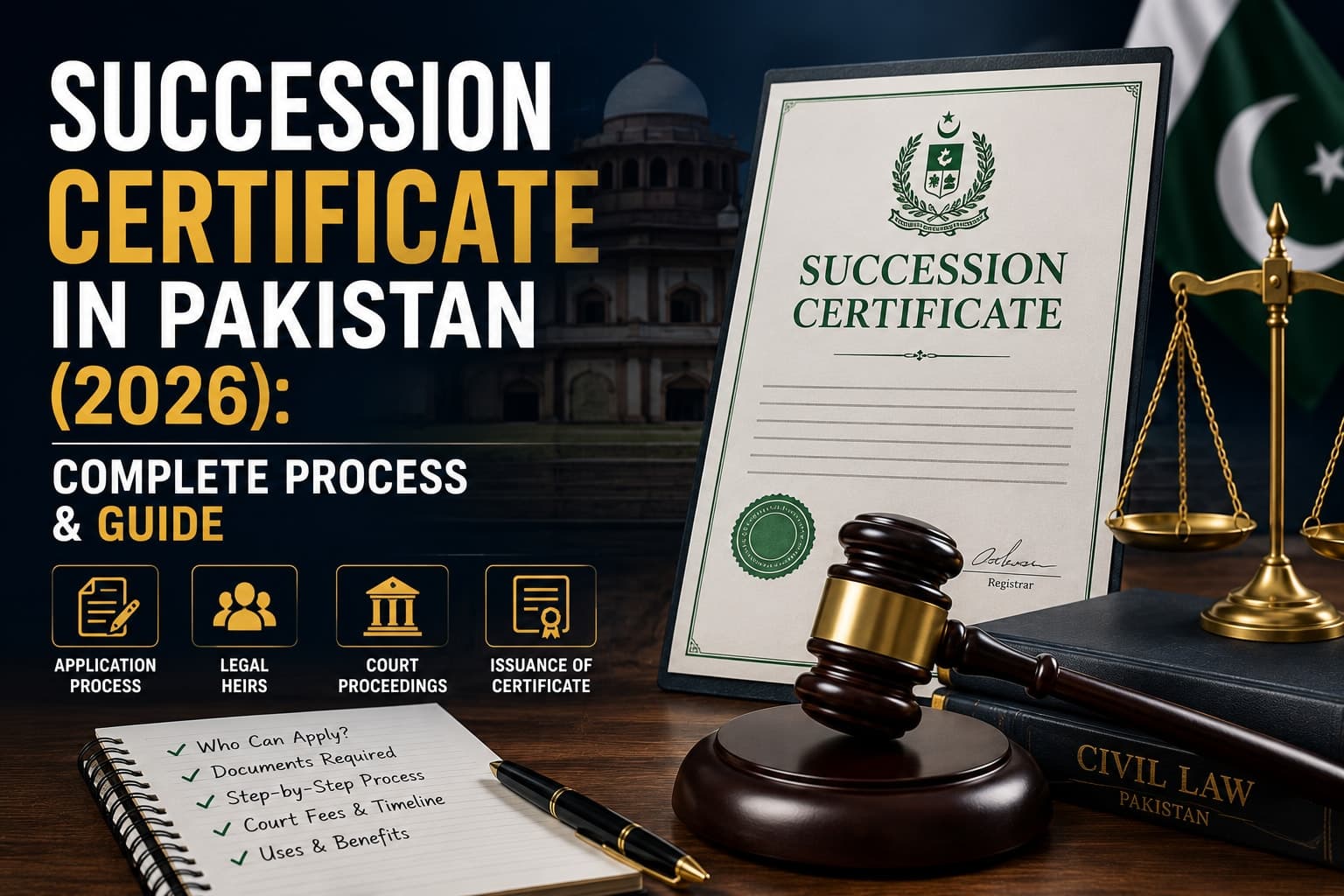
Without a succession certificate, banks and financial institutions are legally unable to release funds to the deceased's family, regardless of how obvious the heirship may seem.
When is a Succession Certificate required vs. not?
Required for: moveable financial assets in Pakistan — bank accounts, NSS, shares, insurance.
Not required for (but other process needed): immoveable property (land, houses, plots). For property, mutation (intiqal) is the process, along with supporting heirship documents. A succession certificate alone does not transfer immoveable property, though it is sometimes cited alongside the mutation process.
Other related documents:
- Letter of Administration — sometimes required for broader estate administration in certain circumstances
- Probate — for estates with a Will; rarely used in Pakistan's Muslim personal law context
Which law governs succession certificates?
The Succession Act, 1925 governs the procedural aspects of succession certificates in Pakistan. The substantive rights of heirs (who inherits how much) are governed by the applicable personal law — for Muslims, this is Islamic law under the Muslim Personal Law (Shariat) Application Act, 1962.
Which court issues a Succession Certificate?
The petition is filed in the District Court (Sessions Court) of the district where:
- The deceased ordinarily resided at the time of death, OR
- Any part of the moveable assets is located
In Karachi, the relevant courts are the District and Sessions Courts for the relevant district (South, East, West, Central, Malir, or Korangi, depending on the location).
What is the procedure for Succession Certificate in Pakistan?
What documents are required for Succession Certificate in Pakistan?
Gather all relevant documents:
- Death certificate of the deceased (issued by NADRA or local authority)
- Family Registration Certificate (FRC) from NADRA — listing all registered family members (heirs)
- CNICs of all heirs
- Details of the assets — bank account numbers, institution names, approximate balance, NSS certificate numbers, share details
- Nikah Nama of the deceased (if relevant for establishing family relationships)
What is the procedure for Succession Certificate in Pakistan?
Your lawyer files a petition in the relevant District Court, stating:
- The deceased's full name, CNIC, date of death, and last address
- The names, CNICs, and relationship of all legal heirs
- Details of the assets for which the certificate is sought
- A request for the certificate specifying each heir's share
How much does Succession Certificate in Pakistan cost in Karachi?
A court fee is payable on the petition, calculated as a percentage of the value of the assets stated in the petition. The fee is paid at filing. Confirm the current rate with your lawyer.
What should you know about Step 4 — Publication of notice in newspaper?
The court directs that a notice be published in a newspaper (typically a daily newspaper circulating in the area) informing the public that the petition has been filed and inviting any person who disputes the claim to appear before the court. This is a mandatory procedural step.
What should you know about Step 5 — Waiting period after publication?
After publication, there is a waiting period for any objections to be filed. If no objection is received within the specified time, the court can proceed.
What documents are required for Succession Certificate in Pakistan?
If no objections are filed, the court holds a brief hearing to confirm the facts. The petitioner (or their lawyer) presents evidence — death certificate, FRC, CNICs — to establish the identity of the deceased and the heirs.
What should you know about Step 7 — Succession Certificate issued?
The court issues the Succession Certificate, naming each heir and their proportionate share. The certificate is signed and stamped by the court.
What should you know about Step 8 — Present to bank / institution?
The original succession certificate (and copies as required) is presented to the relevant bank, National Savings Centre, or other institution. They update their records and release / transfer the assets to the heirs in their stated shares.
How long does the succession certificate process take?
An uncontested succession certificate in Karachi typically takes 2–4 months from filing to issuance, depending on the court's schedule and how quickly the newspaper publication requirement is completed. If an objection is filed by any person (a disputed heir, a creditor, etc.), the matter proceeds as a full hearing and takes longer.
What if there is a dispute among heirs?
If heirs disagree about the shares, or if someone contests another person's status as an heir, the succession certificate application becomes contested. The court then hears both sides and decides before issuing the certificate. Contested applications take longer and require legal representation.
Succession certificate vs. mutation — which do you need?
| Need to access | What you need |
|---|---|
| Bank accounts / NSS / shares | Succession Certificate (court) |
| Transfer property (land/house) to heirs' names | Mutation (intiqal) at land authority |
| Both financial assets AND property | Both — succession certificate + mutation |
A complete estate administration for most Pakistani families requires both processes running in parallel. Your lawyer handles both.
Which Pakistani laws apply to Succession Certificate in Pakistan?
Adv Zain Ul Abdin Kharal at Kharal Law Associates handles succession certificate petitions across Karachi — DHA, Clifton, PECHS, Gulshan, Gulistan-e-Johar, North Nazimabad, Saddar, Korangi, Malir, and North Karachi. We also coordinate the parallel mutation process for immoveable property and assist overseas Pakistani heirs through a power of attorney.
What is the procedure for Succession Certificate in Pakistan?
WhatsApp Adv Zain Ul Abdin Kharal or call +9230000872473 — we file the petition and manage the entire process.
General legal information — not legal advice on your specific case. Court fees, timelines, and procedures can vary — consult a qualified lawyer.
Frequently Asked Questions
A court-issued document establishing the legal heirs of a deceased person, authorising them to deal with the deceased's moveable assets (bank accounts, NSS, shares). Required by banks and financial institutions before they release assets.
The District Court (Sessions Court) of the district where the deceased lived or where the assets are held — South, East, West, Central, Malir, or Korangi, as applicable.
Typically 2–4 months for an uncontested application in Karachi, depending on the court's schedule and newspaper publication timelines.
No — immoveable property is dealt with through mutation (intiqal) at the relevant land authority, not through a succession certificate. You need both for a complete estate.
Yes — through a properly attested power of attorney, a Karachi lawyer can file and pursue the succession certificate petition on your behalf.
The application becomes contested. The court hears both sides and decides. This takes longer and requires legal representation — contact a lawyer immediately if a dispute arises.
Need a Lawyer for This in Karachi?
Our advocates can help. Explore the related practice area:

Written / Reviewed by
Advocate Zain ul Abdin KharalAdvocate High Court, Sindh High Court Bar Association
Litigation, Advisory & Representation