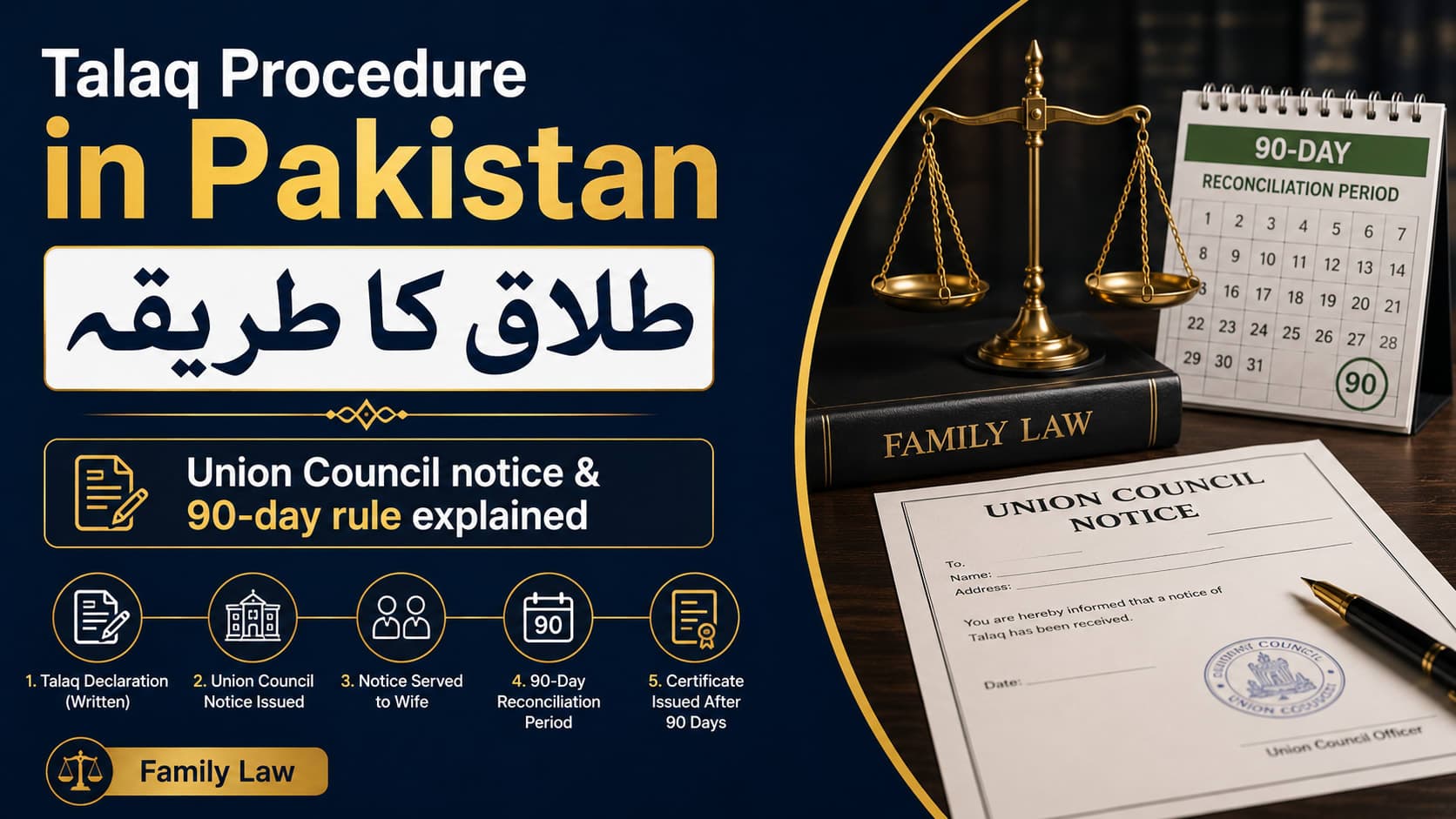
Talaq Procedure in Pakistan (2026): Union Council Notice, 90 Days & Certificate
Talaq is the divorce initiated by the husband in Pakistan, and to be legally effective it must be processed through the Union Council under Section 7 of the Muslim Family Laws Ordinance, 1961. Simply pronouncing talaq is not enough on its own — the husband must give written notice to the Chairman of the Union Council and a copy to the wife, after which a 90-day reconciliation period runs before the divorce becomes final. This guide explains the correct talaq procedure step by step, the role of the Union Council, and how to obtain the divorce certificate.
If you need help giving or registering a talaq correctly in Karachi, message Kharal Law Associates on WhatsApp for a confidential consultation.
What is talaq under Pakistani law?
Talaq is the dissolution of a Muslim marriage initiated by the husband. While the religious pronouncement of talaq matters, Pakistani law adds a mandatory civil procedure on top of it: the talaq is not legally complete until proper notice is given to the Union Council and the statutory waiting period has passed. This requirement exists to protect both parties, allow time for reconciliation, and create an official record of the divorce.
This is the single most misunderstood point about talaq in Pakistan: many people believe that saying "talaq" three times instantly and finally ends the marriage in the eyes of the law. Legally, that is not how it works — without the Union Council notice, the talaq is not effective under Section 7.
Which law governs the talaq procedure?
The talaq procedure is governed primarily by Section 7 of the Muslim Family Laws Ordinance, 1961. This section sets out the steps a husband must follow for a valid, legally recognised talaq, including written notice to the Union Council and the 90-day period before the divorce takes effect. The West Pakistan Family Courts Act, 1964 governs any related disputes that go to the Family Court, such as maintenance or custody.
What is the procedure for Talaq Procedure in Pakistan: Union Council Notice, 90 Days & Certificate?
What should you know about Step 1 — Pronouncement of talaq?
The husband pronounces talaq. This can be done verbally or in writing. However, the pronouncement alone does not legally finalise the divorce — the next step is mandatory.
What should you know about Step 2 — Written notice to the Union Council?
The husband must, as soon as possible after pronouncing talaq, give written notice to the Chairman of the Union Council of the area where the wife resides. A copy of this notice must also be delivered to the wife. This is the legal heart of the procedure — without it, the talaq is not effective under Section 7.
What should you know about Step 3 — Constitution of the Arbitration Council?
On receiving the notice, the Chairman constitutes an Arbitration Council, with representatives of both spouses, to attempt reconciliation between the parties. Both sides are given the opportunity to resolve their differences.
What should you know about Step 4 — The 90-day reconciliation period?
The talaq does not take effect until 90 days have passed from the date the Chairman receives the notice. If the wife is pregnant, the talaq does not take effect until 90 days have passed or the pregnancy ends, whichever is later. This period allows time for genuine reconciliation.
What should you know about Step 5 — Revocation (if the couple reconciles)?
During the 90-day period, the talaq can be revoked if the spouses reconcile. If they decide to continue the marriage within this window, the divorce does not take effect.
What should you know about Step 6 — Talaq becomes effective and certificate is issued?
If reconciliation fails and 90 days pass, the talaq becomes effective. The Union Council then issues a divorce certificate (talaq nama / divorce certificate), which is the official proof of divorce needed for remarriage, visa matters, and NADRA records.
Why is the Union Council notice so important?
Skipping the Union Council notice is the most common — and most damaging — mistake in talaq cases. Without proper notice:
The talaq may not be legally effective, meaning the marriage technically still exists in law.
The wife may face problems proving her marital status for remarriage or other legal purposes.
There can be serious legal consequences for failing to follow the statutory procedure.
A divorce that is not properly processed can create severe complications years later. Doing it correctly the first time protects everyone.
What is iddat and how does it relate to talaq?
Iddat is the waiting period a woman observes after divorce before she can remarry. It overlaps with the legal process: the 90-day Union Council period and the iddat together ensure clarity about the woman's status and any pregnancy. A woman should not remarry until the talaq is effective and her iddat is complete.
Talaq vs khula — who initiates and where?
It is worth being clear about the difference:
Talaq is initiated by the husband and processed through the Union Council.
Khula is initiated by the wife and decided by the Family Court, and does not require the husband's consent.
If a wife wants to end the marriage and the husband will not give talaq, her route is khula, not talaq.
What should you know about Talaq-e-tafweez: a wife's delegated right?
In some cases, the right to pronounce talaq is delegated to the wife in the Nikah Nama (this is called talaq-e-tafweez). If this column in your marriage contract was filled in granting the wife this right, she may be able to exercise a form of divorce herself. It is worth checking your Nikah Nama with a lawyer, as many people are unaware of what their marriage contract actually says.
What is the procedure for Talaq Procedure in Pakistan: Union Council Notice, 90 Days & Certificate?
Not sending notice to the Union Council — the most serious error, as it can leave the talaq legally ineffective.
Sending notice to the wrong Union Council — it should generally go to the council of the area where the wife resides.
Assuming the divorce is instant — the 90-day period is mandatory.
Not keeping proof of the notice and the certificate.
Relying on verbal arrangements instead of proper documentation.
Which Pakistani laws apply to Talaq Procedure in Pakistan: Union Council Notice, 90 Days & Certificate?
Kharal Law Associates assists clients with the talaq procedure across Karachi, including DHA, Clifton, Gulshan-e-Iqbal, Gulistan-e-Johar, North Nazimabad, Nazimabad, PECHS, Bahadurabad, Saddar, Korangi, Malir, and North Karachi. We ensure the Union Council notice is served correctly, the procedure is followed, and you receive a valid divorce certificate.
We also help overseas Pakistanis give or register a talaq in Pakistan correctly through a power of attorney, so the process is legally sound even when you are abroad.
Frequently Asked Questions
No. Under Section 7 of the Muslim Family Laws Ordinance, 1961, a talaq is not legally effective unless written notice is given to the Chairman of the Union Council and a copy to the wife.
The talaq becomes effective 90 days after the Chairman of the Union Council receives the notice, provided reconciliation fails. If the wife is pregnant, it takes effect after 90 days or the end of the pregnancy, whichever is later.
Yes. During the 90-day period, the spouses can reconcile and revoke the talaq, in which case the divorce does not take effect.
The wife can seek khula through the Family Court, which can dissolve the marriage without the husband's consent.
Yes. The talaq procedure, including the Union Council notice, can be handled in Pakistan through a power of attorney so that it is legally valid.
Need a Lawyer for This in Karachi?
Our advocates can help. Explore the related practice area:

Written / Reviewed by
Advocate Zain ul Abdin KharalAdvocate High Court, Sindh High Court Bar Association
Litigation, Advisory & Representation